
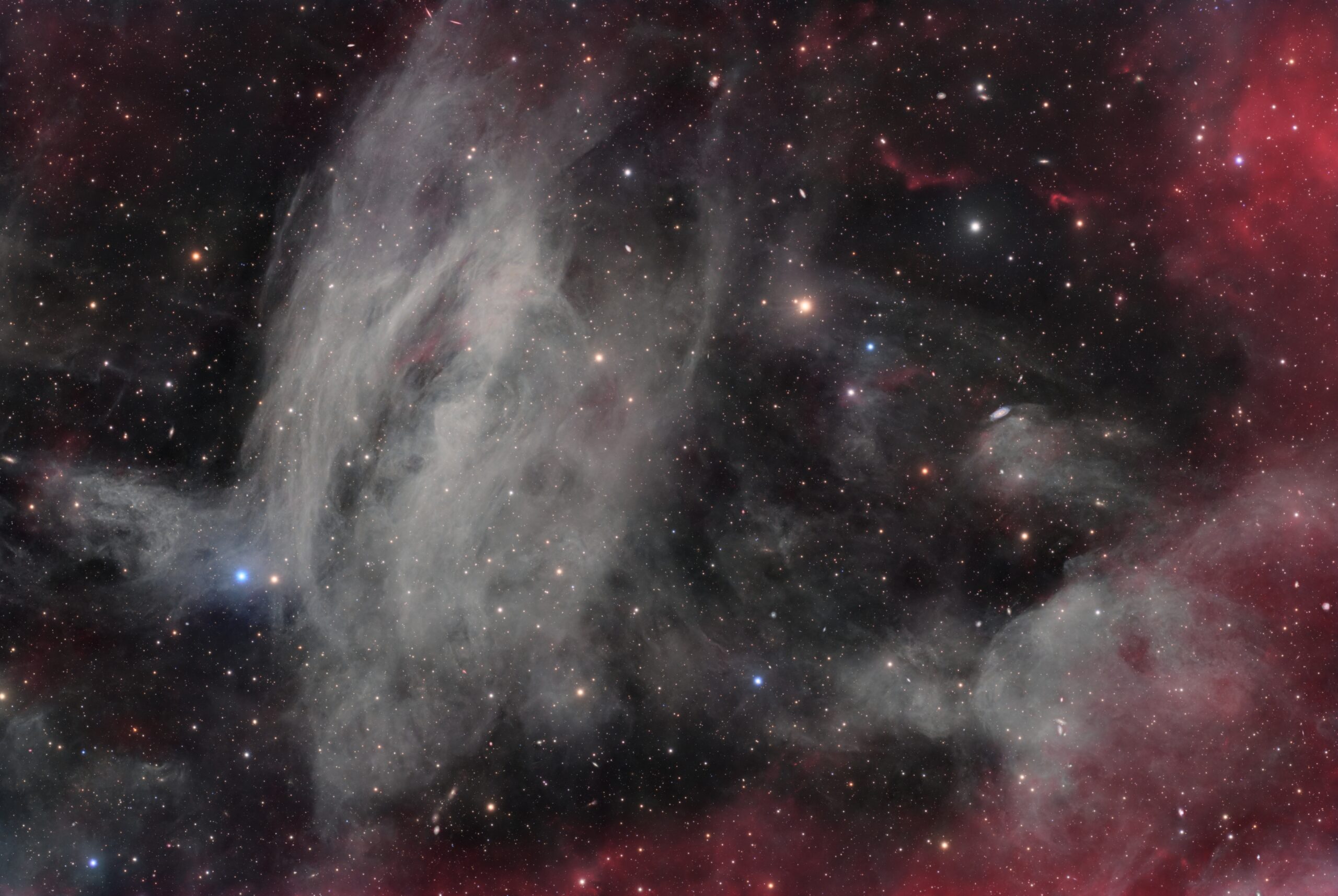
LBN 105 (aka Sh2-73)
by Anthony Saab
Published: May 24, 2025
Total integration: 61h
Integration per filter:
Lum/Clear: 13h 20m (160 × 300″)
R: 7h 20m (44 × 600″)
G: 4h 40m (28 × 600″)
B: 8h 40m (52 × 600″)
Hα: 27h (81 × 1200″)
Telescope: William Optics RedCat 91 WIFD
Camera: ZWO ASI2600MM DUO
Mount: ZWO AM5N
Filters: Antlia 3nm Narrowband H-alpha 2″, Antlia V-Pro Blue 2″, Antlia V-Pro Green 2″, Antlia V-Pro Luminance 2″, Antlia V-Pro Red 2″
Software: Adobe Photoshop, Pleiades Astrophoto PixInsight, Stefan Berg Nighttime Imaging ‘N’ Astronomy (N.I.N.A. / NINA)
For more information, visit AstroBin
LBN 105, also cataloged as Sh2-73, is a rarely imaged and enigmatic object located in the constellation Hercules, at a high galactic latitude — far from the bustling plane of the Milky Way. Unlike classic emission nebulae, this faint and diffuse structure is believed to be a high galactic cirrus cloud — part of the so-called Integrated Flux Nebula (IFN) that reflects the combined starlight of our galaxy.
Often misclassified as an emission nebula in older catalogs, LBN 105 shows little to no actual ionized gas. Instead, it appears as a faint reflection nebula, dominated by interstellar dust scattering ambient galactic light. The result is a ghostly, filamentary structure with extremely low surface brightness, making it a challenging target even under pristine dark skies.
This object highlights the quiet, dust-filled outskirts of our galaxy, and reminds us that the interstellar medium stretches far beyond the well-known star-forming regions. Capturing LBN 105 requires long integration times, precise calibration, and patience — making it a true deep-sky prize for dedicated astrophotographers.