
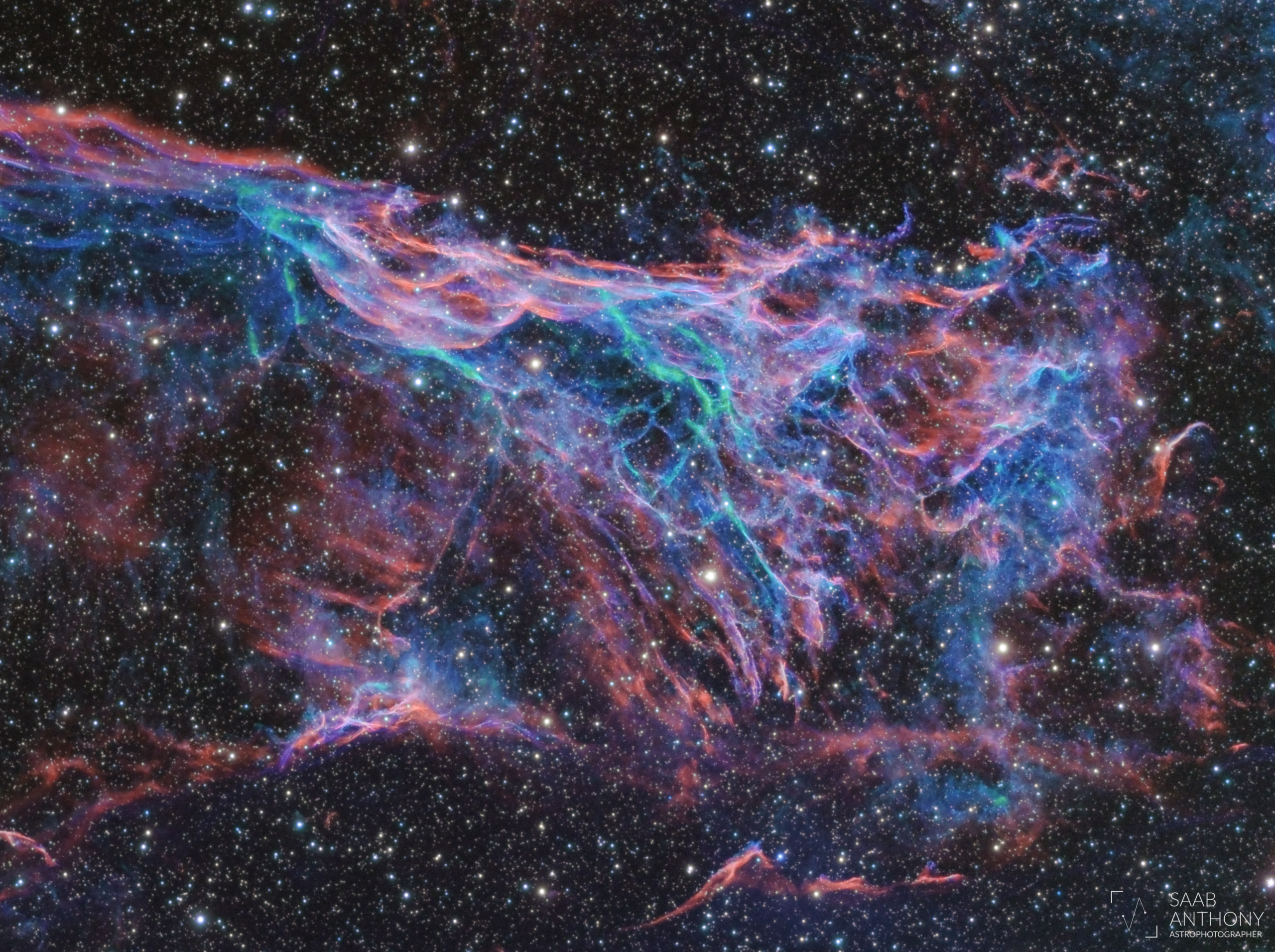
Pickering’s Triangle
by Anthony Saab
Published: Sep 2, 2021
Total integration: 21h 50m
Integration per filter:
Hα: 7h 40m (46 × 600″)
SII: 7h 30m (45 × 600″)
OIII: 6h 40m (40 × 600″)
Optics: TS-Optics PHOTOLINE TS 80 Photo Line APO F6
Camera: ZWO ASI 1600 MM Cool Pro
Mount: Celestron AVX
Filters: ZWO S2 1.25″, ZWO Ha 1.25″, ZWO O3 1.25″
Software: Stefan Berg Nighttime Imaging ‘N’ Astronomy (N.I.N.A. / NINA)
For more information, visit AstroBin
Pickering’s Triangle is a hauntingly beautiful filament of ionized gas located within the Veil Nebula, the expansive remnant of a massive star that exploded around 8,000 years ago. Situated in the constellation Cygnus, the Veil Nebula is one of the best-known supernova remnants in the sky, and Pickering’s Triangle is one of its most intricate and delicate features.
This structure is named after Edward Charles Pickering, although the actual discovery is attributed to Williamina Fleming, one of the famed “Harvard Computers.” It lies between the more prominent Western Veil (NGC 6960) and Eastern Veil (NGC 6992/6995), and presents a chaotic web of intertwined filaments, shaped by shock waves as they tear through interstellar space.
Pickering’s Triangle glows from ionized oxygen, hydrogen, and sulfur, producing the characteristic blue-green and red hues captured in narrowband astrophotography. Its wispy structure and incredible detail make it a favorite target for imagers, especially under dark skies with long exposures.
This ghostly formation is a reminder of the explosive death of a massive star — and the complex beauty left in its wake.