
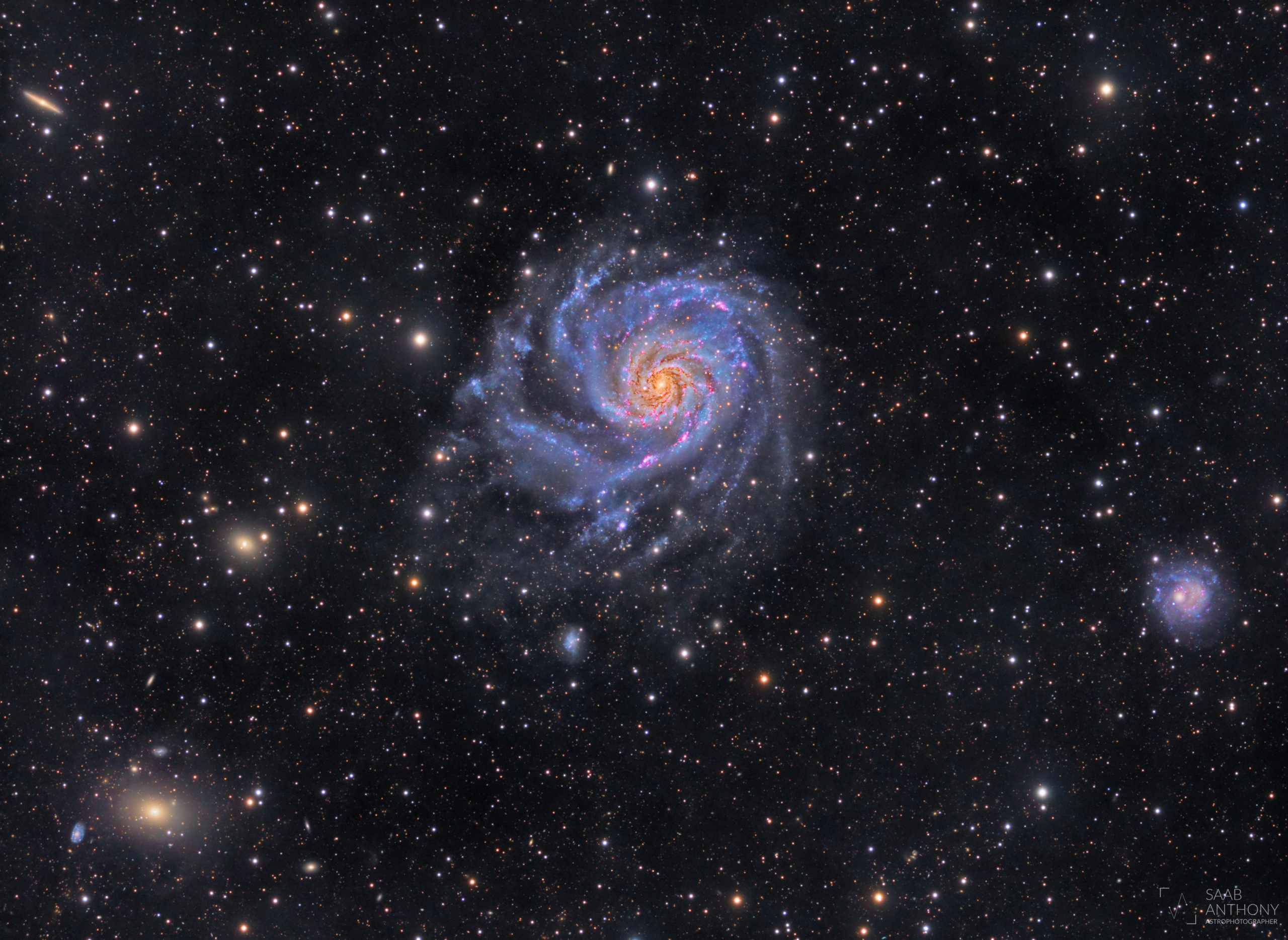
M101 – The Pinwheel Galaxy
by Anthony Saab
Published: Jul 1, 2022
Telescope: TS-Optics Photoline 80mm f/6 (TLAPO804)
Camera: ZWO ASI1600MM Pro
Mount: Celestron Advanced VX
Software: Adobe Photoshop, Pleiades Astrophoto PixInsight, Stefan Berg Nighttime Imaging ‘N’ Astronomy (N.I.N.A. / NINA)
For more information, visit AstroBin
Messier 101 (M101), famously known as the Pinwheel Galaxy, is a magnificent face-on spiral galaxy located in the constellation Ursa Major, approximately 21 million light-years from Earth. With a diameter of over 170,000 light-years, it is nearly twice the size of the Milky Way, making it one of the largest and most detailed spirals visible in amateur telescopes.
M101 is a classic example of a grand design spiral galaxy, with beautifully defined arms that span outward in sweeping curves. These arms are rich in star-forming regions, glowing with hydrogen-alpha emission from young, hot stars energizing surrounding gas clouds. Several prominent H II regions can be seen throughout the disk — massive nurseries where stellar formation is actively occurring.
Despite its elegant structure, M101 also shows signs of gravitational interaction with its smaller satellite galaxies, which have slightly distorted its symmetry and contributed to bursts of star formation in its spiral arms.
In deep images, the galaxy reveals faint outer structures, tidal features, and a soft extended halo — offering a glimpse into both the beauty and complexity of galactic evolution. For astrophotographers, M101 is a richly rewarding subject, combining color, structure, and subtle detail in one expansive target.