
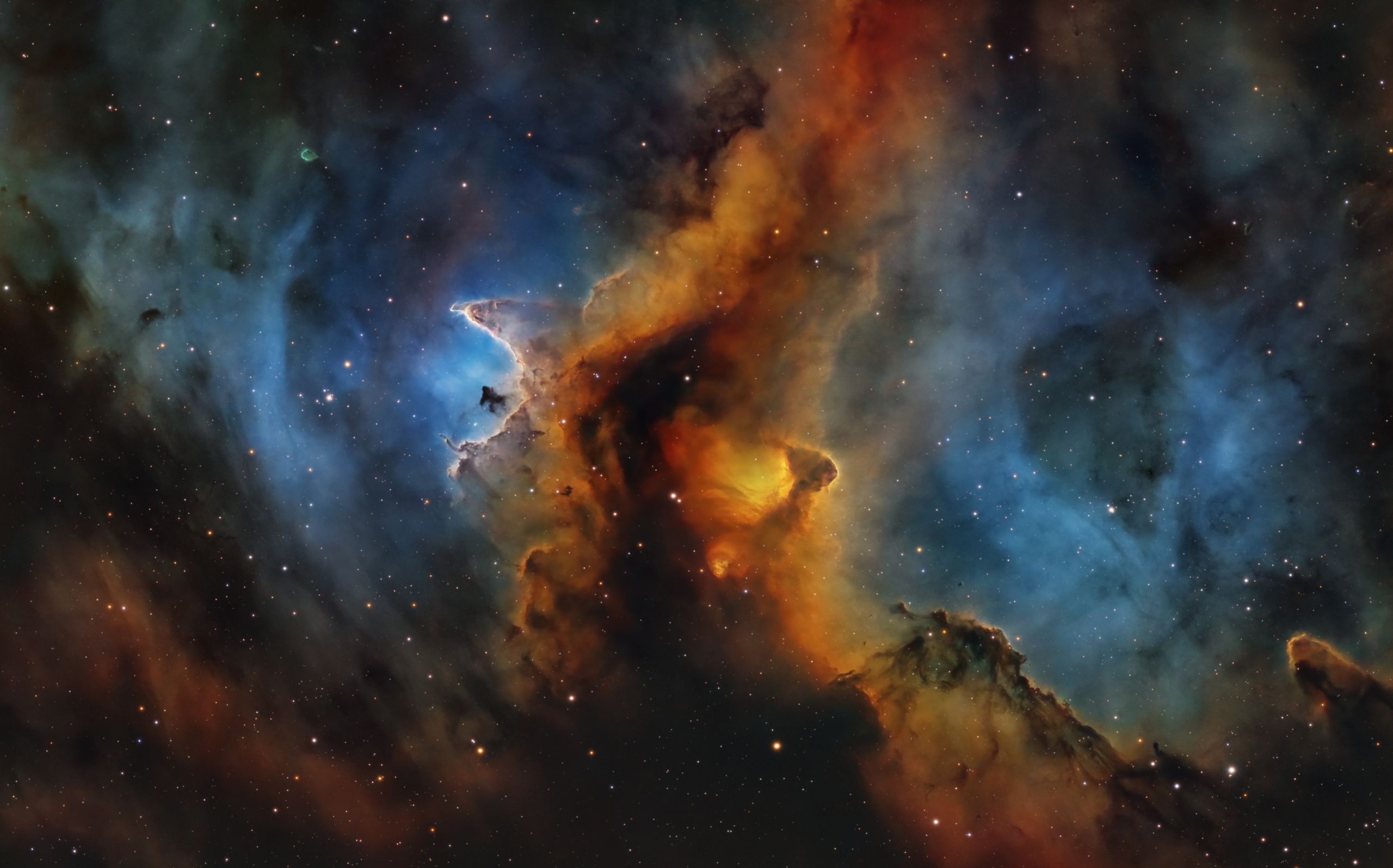
IC 1848 – Soul Nebula
by Anthony Saab
Published: Oct 23, 2024
Total integration: 42h 40m
Integration per filter:
Hα: 18h 20m (110 × 600″)
SII: 9h 40m (58 × 600″)
OIII: 14h 40m (88 × 600″)
Telescope: TS-Optics Photoline 80mm f/6 (TLAPO804)
Camera: ZWO ASI533MM Pro
Mount: ZWO AM5
Filters: Antlia 3nm Narrowband H-alpha 1.25″, Antlia 3nm Narrowband Oxygen III 1.25″, Antlia 3nm Narrowband Sulfur II 1.25″
Software: Pleiades Astrophoto PixInsight, Stefan Berg Nighttime Imaging ‘N’ Astronomy (N.I.N.A. / NINA)
For more information, visit AstroBin
The Soul Nebula (also known as Westerhout 5, IC 1848, or Sharpless 2-199) is a vast emission nebula and stellar nursery located in the constellation Cassiopeia, roughly 6,500 light-years from Earth. It lies right next to the Heart Nebula (IC 1805), forming the famous “Heart and Soul” pair — a favorite subject in wide-field astrophotography.
Spanning nearly 100 light-years, the Soul Nebula glows with the deep red light of ionized hydrogen, energized by intense ultraviolet radiation from embedded young, massive stars. These stars were born within the nebula itself, and their radiation shapes the surrounding gas into pillars, ridges, and glowing arcs.
The nebula contains several open star clusters — including IC 1848, from which the nebula gets one of its names. These clusters are filled with young stars that are still in the early stages of their lives, making the Soul Nebula a vivid example of ongoing star formation.
Through narrowband imaging, the Soul Nebula reveals incredible textures — from smooth glowing clouds to sharp, pillar-like structures, all sculpted by stellar winds and radiation pressure. It’s both scientifically rich and visually captivating, representing the creative force of our galaxy at work.