
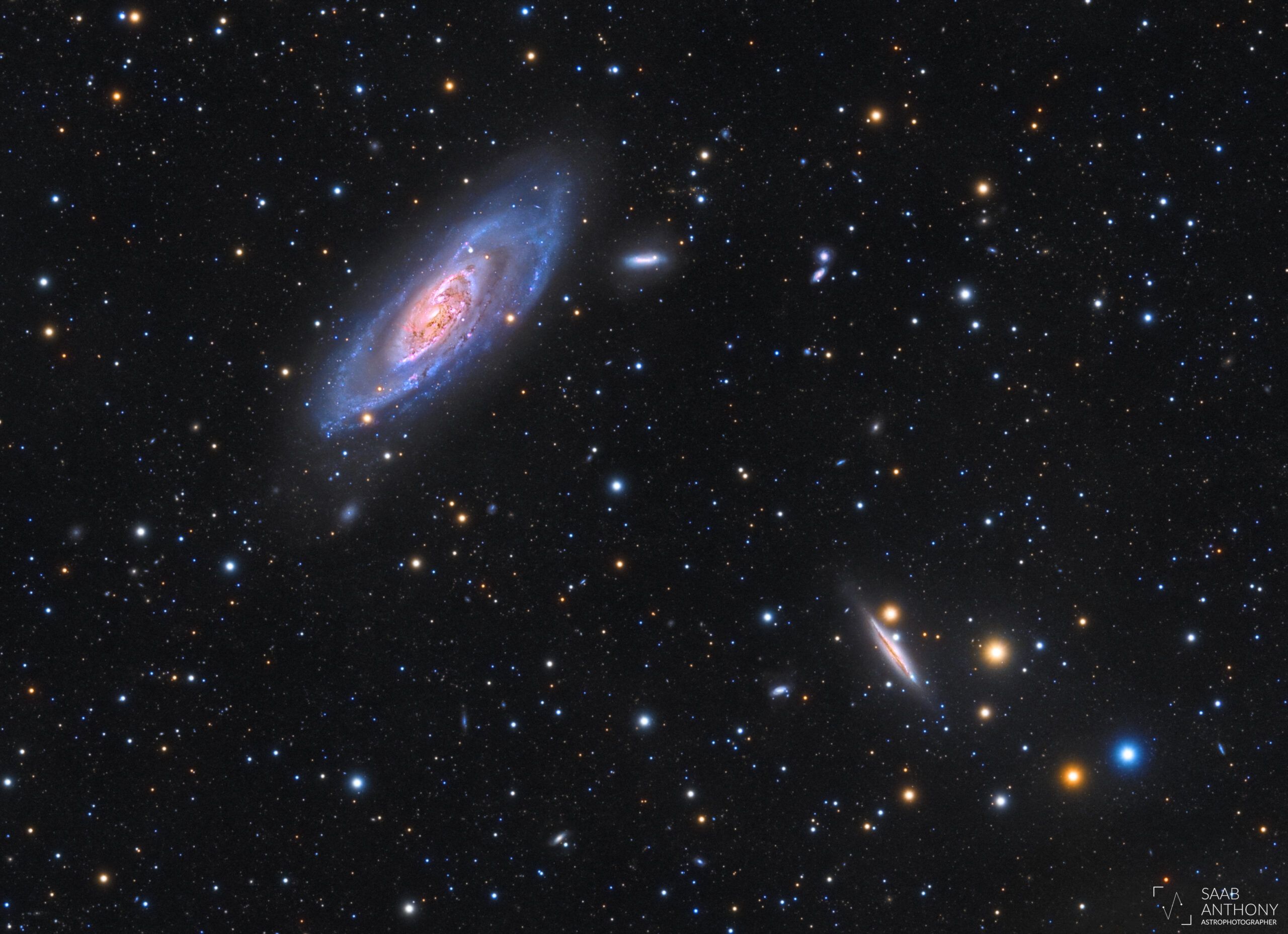
M106 & NGC 4217
by Anthony Saab
Published: May 16, 2021
Total integration: 20h
Integration per filter:
ZWO LRGB, 1.25″: 20h (400 × 180″)
Optics: TS-Optics PHOTOLINE TS 80 Photo Line APO F6
Camera: ZWO ASI183MM Pro
Filter: ZWO LRGB, 1.25″
Software: Stefan Berg Nighttime Imaging ‘N’ Astronomy (N.I.N.A. / NINA)
For more information, visit AstroBin
Messier 106 (NGC 4258)
Located approximately 22–25 million light-years away, M106 is a Seyfert galaxy, meaning its core harbors an actively feeding supermassive black hole. This activity results in intense radiation and strange emission patterns not typical of normal spiral galaxies. In fact, M106 exhibits “anomalous arms” — faint jets of ionized gas that extend outward from its nucleus, likely caused by energetic activity near the black hole rather than star formation.
The galaxy’s tight spiral structure and bright core make it a popular target for both amateur and professional astronomers. It is one of the closest known examples of an active galactic nucleus (AGN), offering insight into galactic evolution and central black hole dynamics.
NGC 4217
Lying just a few arcminutes away from M106, NGC 4217 is a spiral galaxy viewed edge-on, located about 60 million light-years from Earth. Its slender profile reveals a prominent dust lane cutting through the galactic disk — a beautiful contrast to the face-on view of M106. While not physically associated with M106, the two galaxies form a compelling visual pairing in wide-field images.