
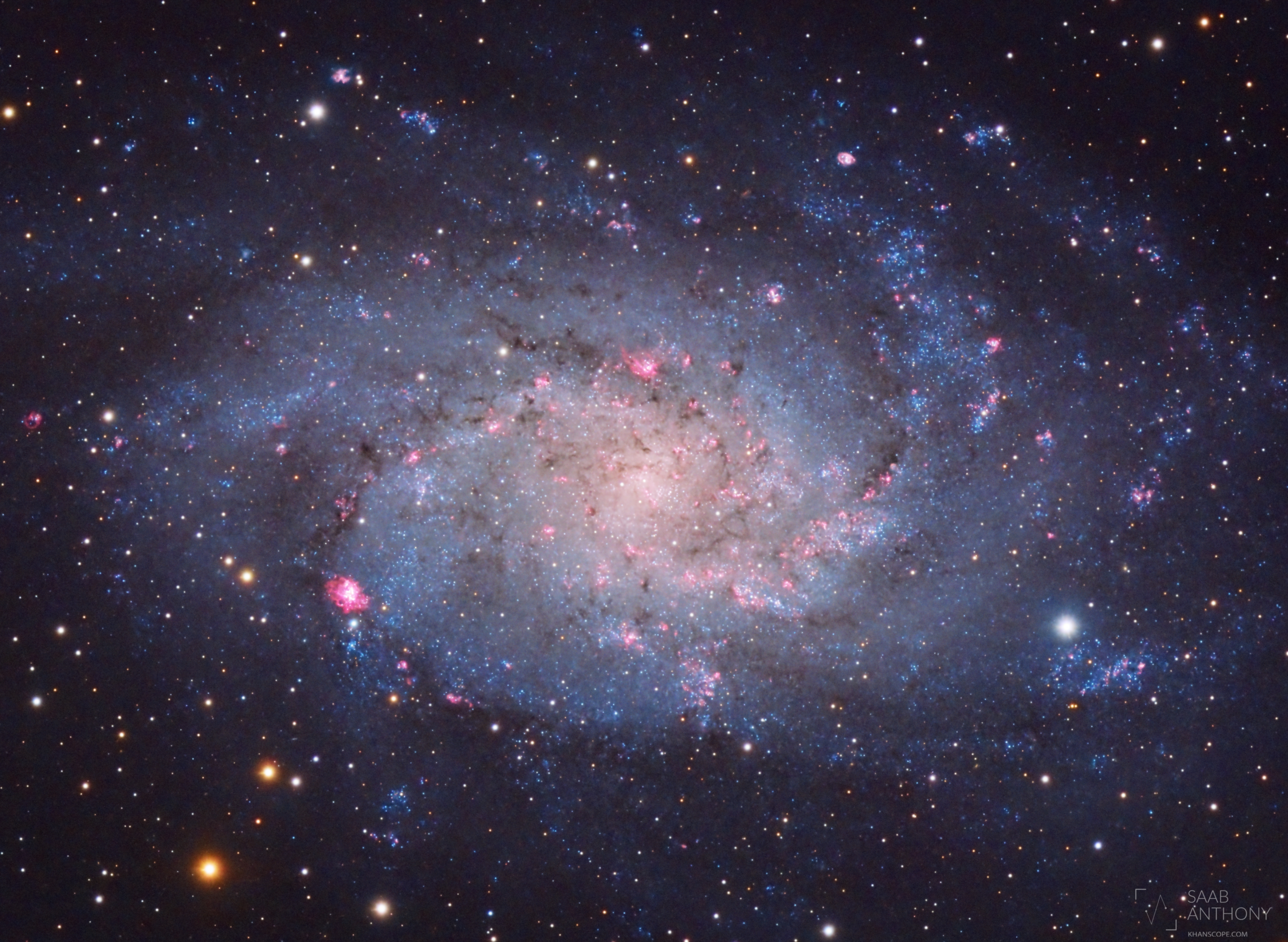
M33 – The Triangulum Galaxy
by Anthony Saab
Published: Nov 17, 2024
Total integration: 10h
Integration per filter:
No filter: 10h (200 × 180″)
Telescope: TS-Optics Photoline 80mm f/6 (TLAPO804)
Camera: ZWO ASI1600MM Pro
Mount: ZWO AM5
For more information, visit AstroBin
Messier 33 (M33), known as the Triangulum Galaxy, is the third-largest member of our Local Group of galaxies, after the Andromeda Galaxy (M31) and the Milky Way. Located about 2.7 million light-years away in the small northern constellation Triangulum, M33 is a spectacular face-on spiral galaxy that spans nearly 60,000 light-years in diameter.
What makes M33 especially compelling is its rich network of H II regions — areas of active star formation where glowing hydrogen gas lights up in vibrant pinks and reds. The most prominent of these is NGC 604, one of the largest known star-forming regions in any nearby galaxy, spanning nearly 1,500 light-years — much larger than the Orion Nebula.
The galaxy’s spiral arms are loosely wound, giving M33 an open and airy appearance compared to more tightly structured spirals like M51. These arms are filled with young blue stars, clusters, and emission nebulae, making M33 an ideal object for both visual observation and deep-sky imaging.
Despite its relatively close distance, M33 is low in surface brightness, making it a challenging target under light-polluted skies — but under dark skies, it reveals remarkable structure and detail, especially in long-exposure astrophotography.
M33 is not only beautiful but also scientifically significant, offering insight into galactic structure, star formation, and the dynamics of spiral galaxies in our local cosmic neighborhood.